Monday, 3 August 2015

                                   THE WOW SIGNAL


Of the many "maybe's" that SETI has turned up in its four-decade history, none is better known than the one that was discovered in August, 1977, in Columbus, Ohio. The famous Wow signal was found as part of a long-running sky survey conducted with Ohio State University's "Big Ear" radio telescope.

The Wow signal's unusual nomenclature connotes both the surprise of the discovery and its sox-knocking strength (60 Janskys in a 10 KHz channel, which is more than 50 thousand times more incoming energy than the minimum signal that would register as a hit for today's Project Phoenix.)

But is the Wow signal's notoriety merely the triumph of marketing over substance? Could this momentary cosmic burp have really been ET, or was it just random terrestrial interference dressed up with a sexy moniker? For a decade, Robert Gray, a long-time, independent SETI researcher from Chicago, has been trying to find out.

Gray, like many others, was attracted by an intriguing feature of the Wow signal: the manner in which it rose and fell over the course of 72 seconds.

Why is this interesting?

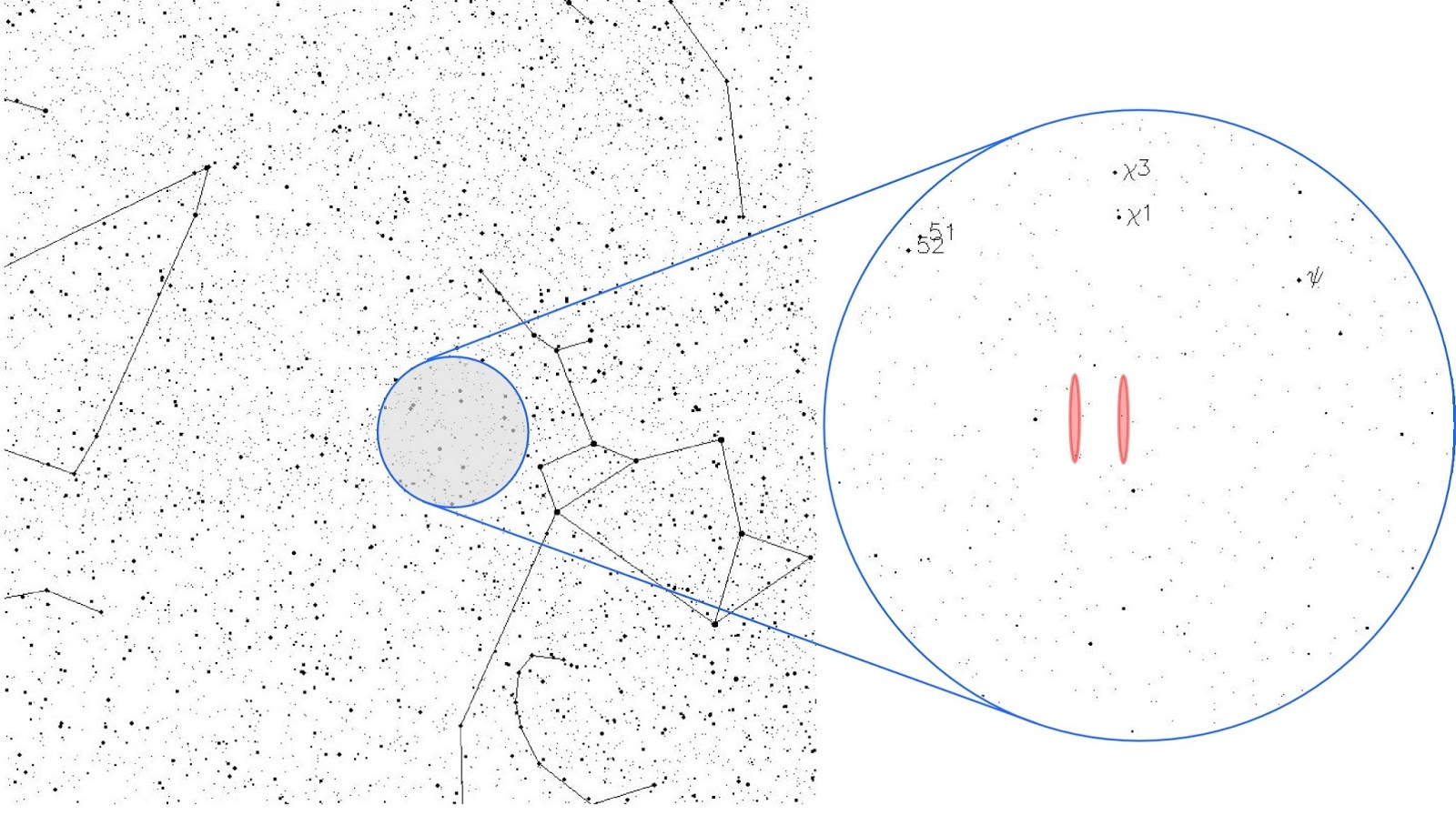
Just this: the Ohio State survey kept the telescope fixed, letting the Earth's daily spin rotate the heavens through its narrow beam. The "beam," of course, was the elongated patch of sky to which the telescope was sensitive - the direction from which it could pick up cosmic signals. The sensitivity was greatest at the center of the beam, falling off to either side.

So as a celestial radio source passed by, it first rose in apparent intensity as Earth's rotation brought it into the beam, reached a peak in the beam center, and then faded away.

Given the size of the Ohio State beam, this rise and fall should take 72 seconds. And for the Wow signal, it did.

Now contrast this with what you'd expect if the telescope had merely been briefly flooded by an interfering terrestrial signal. The intensity would suddenly switch full on, and then, sometime later, switch off. Even if the interference was due to a low-Earth orbit satellite, a source that might cause a rise and fall in intensity, you wouldn't expect it to fortuitously last for 72 seconds.

For these reasons, the Wow signal gets high marks for being a credible candidate for SETI.

On the other hand, there are some aspects of this seductive signal that nudge it toward a lower grade. The Ohio State telescope actually used two beams, situated side-by-side on the sky. Any cosmic source would therefore be seen first in one (for 72 seconds) and then - roughly 3 minutes later - in the other (also 72 seconds.) The Wow signal failed this simple test. It came on gangbusters in one beam, but was a no-show in the other: suspicious and disheartening.

But as Gray and others have realized, this odd, one-beam behavior could be caused by an alien transmission that simply went off the air during the 3 minutes between beams.

Maybe ET went on vacation, or took an extended lunch break. If the putative aliens permanently shut down their transmitter, then there's no chance of ever hearing the Wow signal again. Like a single sighting of the Loch Ness monster, we would never be able to prove what it was. But if the signal is periodic - if, for example, the aliens are using a rotating radio beacon that sweeps the star-studded strata of the Milky Way once every five minutes or every five hours - then we could hope to find it by just looking again.

Robert Gray has looked again. And again. In the last decade, Gray and his colleagues have used the Harvard META SETI system and then the Very Large Array (VLA) to search for a reappearance of the Wow signal. 


The experiment at the VLA, in particular, was an impressive effort, as it was far more sensitive than the original Ohio State equipment and covered more of the band. Neither attempt succeeded in retrieving the signal, however.

Gray realized that he might be the victim of insufficient patience. The longest of his reobservations had been 22 minutes. What if the aliens' beacon flashed less often than once every 22 minutes? What if their transmitter was fixed to the home planet, rotating (and flashing) once every 20 or 30 hours?

In The Astrophysical Journal, Gray and Simon Ellingsen, of Australia's University of Tasmania, report on new observations (partially supported by the SETI Institute) designed to test this idea. Their new try was made at the 26-meter radio telescope in Hobart, Tasmania. This southern hemisphere instrument could continuously follow for most of a day the patch of sky (in the constellation of Sagittarius) where the "Big Ear" was pointing when it found the 'Wow' signal. They made six 14-hour observations, and even though their telescope was rather smaller than the venerable Ohio State antenna, they still had sufficient sensitivity to find signals only 5% as strong as Wow's 1977 intensity. They also covered five times as much of the radio dial as the original "Big Ear" telescope.

Bottom line? No dice.

To quote from their article, "no signals resembling the Ohio State Wow were detected..."

Of course, if the signal's repetition cycle were much longer than 14 hours, then even this careful experiment could have easily missed it. But as Gray and Ellingsen point out, if the signal were really this infrequent, then the chance to have found it in the first place was very slim.

So was the Wow signal our first detection of extraterrestrials?

It might have been, but no scientist would make such a claim. Scientific experiment is inherently, and rightly, skeptical. This isn't just a sour attitude; it's the only way to avoid routinely fooling yourself.

So until and unless the cosmic beep measured in Ohio is found again, the Wow signal will remain a What signal
Sunday, 2 August 2015


            The mysterious Rongorongo writing of Easter Island

During the 19th Century, ancient artifacts containing a set of etched symbols were discovered on the world-renowned Easter Island, a small remote island located a few thousand miles west of South America, and famous for the hundreds of giant monolithic anthropomorphic statues called moai. The intricate designs appear to be glyphs, or a form of writing, but the meaning of the glyphs has never been deciphered. Some believe that decoding the mysterious writing could offer answers into what caused the collapse of the ancient Easter Island civilization.
The famous moai of Easter Island

The Rongorongo writing was first discovered by Eugène Eyraud, a lay friar of the Roman Catholic Church, who went to Easter Island as a missionary on January 2, 1864. In an account of his visit, he wrote of his discovery of twenty-six wooden tablets containing the unusual inscriptions:
“In every hut one finds wooden tablets or sticks covered in several sorts of hieroglyphic characters: They are depictions of animals unknown on the island, which the natives draw with sharp stones. Each figure has its own name; but the scant attention they pay to these tablets leads me to think that these characters, remnants of some primitive writing, are now for them a habitual practice which they keep without seeking its meaning.”
A mid-section of the Santiago Staff with Rongorongo script

The name Rongorongo comes from the Rapa Nui language, which is the native language of Easter Island, and means "to recite, to declaim, to chant out.” The irregularly shaped wooden tablets were weathered, burned, or otherwise damaged when they were found. The glyphs were also found on a chieftain's staff, a bird-man statuette, and two reimiro ornaments. The glyphs are written in-between lines that run across the tablets. Some tablets are “fluted” with the inscriptions falling within the channels created by the fluting.  The Rongorongo images are shaped like humans, animals, plants, and geometric forms. Every symbol that contains a head is oriented with the head facing up, and either facing forward, or profiling to the right. Each symbol is approximately 1 centimeter high. The orientation of the writing is read from left to right, bottom to top. This is known as reverse boustrophedon. According to oral tradition, the tools used to make the carvings were obsidian flakes or small shark teeth.
The Rongorongo characters

The age of the tablets is unknown, as very little direct dating has been done, but they are believed to have originated around the 13th Century, around the same time as forest clearing.  However, this is merely speculative as the inhabitants of Easter Island may have felled a small number of trees for the specific purpose of creating the wooden tablets.  One glyph appears to resemble a palm tree, and is thought to be the Easter Island palm, which disappeared from the island’s pollen record in 1650, suggesting the script must be at least that old.
Side a of Rongorongo Tablet

Deciphering the glyphs has proven difficult. Assuming that Rongorongo is writing, there are three barriers that make it difficult to decipher: the limited number of texts, the lack of illustrations and other contexts with which to understand them, and poor attestation of the Old Rapanui language, which is likely to be the language reflected in the tablets. Some believe that the Rongorongo is not true writing, but proto-writing, which is a set of symbols that convey information without containing any truly linguistic content. According to the Atlas of Language, the Rongorongo “was probably used as a memory aid or for decorative purposes, not for recording the Rapanui language of the islanders.”
While it remains unclear exactly what the Rongorongo is intended to convey, the discovery and inspection of the tablets remain an important key to understanding the past civilizations of Easter Island. The intricately inscribed, neatly lined images indicate that the ancient island civilization had a message to convey, whether it was a casual display for decorative purposes, or to pass messages and stories forward from generation to generation. Perhaps deciphering the codes will someday lead to answers about the collapse of the island civilization, but for now, the tablets remain a mysterious symbol from the past.


Shugborough inscription


The Shugborough inscription is a sequence of letters - O U O S V A V V, between the letters D M - carved on the 18th-century Shepherd's Monument in the grounds of Shugborough Hall in Staffordshire, England, below a mirror image of Nicolas Poussin's painting, the Shepherds of Arcadia. It has never been satisfactorily explained, and has been called one of the world's top uncracked ciphertexts. 

The inscription became widely known after being mentioned in the 1982 book The Holy Blood and the Holy Grail by Michael Baigent, Richard Leigh, and Henry Lincoln.


The monument was built sometime between 1748 and 1763, commissioned by Thomas Anson, paid for by his brother, Admiral George Anson, and fashioned by the Flemish sculptor Peter Scheemakers. The relief copy of the Poussin painting is contained within a rustic arch, and shows a woman and three shepherds, two of whom are pointing to a tomb. On the tomb is carved the Latin text Et in arcadia ego ("I am also in Arcadia" or "I am, even in Arcadia"). The carving displays a number of small alterations from the original painting, and an extra sarcophagus has been placed on top of the main tomb. Above the Poussin scene are two stone heads, one showing a smiling bald-headed man, the other bearing a likeness to the goat-horned Greek god Pan.
Below the relief carving on the monument, an unknown craftsman carved the mysterious eight letters, contained within the letters 'D M'. On Roman tombs, the letters 'D M' commonly stood for Diis Manibus, meaning "dedicated to the shades".

Theories

Josiah Wedgwood, Charles Darwin and Charles Dickens are all said to have attempted to solve the enigma and failed.[2]
No solution has yet been proposed which rests on a solid cryptanalytic footing.
However, in recent decades, investigators have proposed several possible solutions. Some of these are acrostic, interpreting each letter as the initial letter of a word.
One suggestion is that the eight letters are a coded dedication by George Anson to his deceased wife. In 1951 Morchard Bishop speculated that the letters might be an acronym for the Latin phrase Optimae Uxoris Optimae Sororis Viduus Amantissimus Vovit Virtutibus ("Best of wives, Best of sisters, a most devoted Widower dedicates (this) to your virtues").

Steve Regimbal interprets the letters as standing for a new Latin translation of the phrase "Vanity of vanities, saith the preacher; all is vanity." (Ecclesiastes 12:8), namely Orator Ut Omnia Sunt Vanitas Ait Vanitas Vanitatum. He has speculated that the phrase may be the source of the earlier inscription "OMNIA VANITAS" which may have been carved on an alcove at the estate of one of Thomas Anson's associates, George Lyttleton.

Margaret, Countess of Lichfield has claimed that the inscription was a love message, referring to the lines Out Your Own Sweet Vale, Alicia, Vanishes Vanity. Twixt Deity and Man Thou, Shepherdess, The Way, but no source for these words has ever been traced.
A. J. Morton observes that some of the letters match the names of the residents of Shugborough in the early 19th century, and believes that the inscription denotes the words Orgreave United with Overley and Shugborough, Viscount Anson Venables Vernon.

Non-acrostic efforts include:
a work by Peter Oberg where the letters stand for numbers which sum to 2810, the distance in miles 2810 miles from Shugborough to the so-called "Money Pit" on Oak Island, in Nova Scotia, Canada.
a suggestion that relies on pronouncing 'UOSV' as 'Iosef', interpreted as a reference to the biblical prophet Joseph.
a proposal that 'VV' should be read as 'TEN', with reference to Roman numerals, and the 10 letters then read as an anagram of 'DEVOUT MASON'.


THE EASTER ISLAND


One of the greatest mysteries on Earth are the statutes which stand on Easter Island. Easter Island is one of the most remote islands on Earth. It is in the southern Pacific Ocean, 2,300 miles west of the coast of Chile and 2500 miles southeast of Tahiti. The closest island is 1400 miles away, and that island is uninhabited. Easter Island is only 15 miles long and 10 miles wide. Yet, Easter Island, which was almost uninhabited when it was discovered on Easter Day in 1722 by a Dutch captain, is covered with hundreds of giant statutes, each weighing several tons and some standing more than 30 feet tall.
Who built these statutes and why and how did they get there? 


Nobody knows the answer for sure, but many are trying to find out. It has even been suggested that space aliens may have played a role regarding these giant statues. Many theories abound.
One theory suggests that Easter Island was inhabited by Polynesian seafarers, who traveled thousands of miles in their canoes, guided by the stars, the rhythms of the ocean, the color of sky and the sun, the shapes of clouds, the direction from which the swells were coming, and the presence of birds making flights out to sea seeking food. The Polynesians first arrived on the island in 400 A.D. However, the ocean currents which carried them there would not take them back. They were trapped and, having arrived there, could not leave.


It appears there may have been two classes or races of inhabitants, those with long ears and those with short ears. The long eared people were the rulers. The short eared, who came earlier, were the workers. For this reason, most of the statues have long ears.
Eventually, the short eared people revolted and killed all the long eared people.


There are 887 statutes which have been discovered on the island. However, only a few statues made it to their intended destination. The rest were abandoned along the way.
The statues appear to have been carved out of the top edge of the walls of a volcano on the island. After a statue was carved, it may have been rolled or dragged down to the base of the volcano. Then, it was stood upright and ropes were tied around it. Using a pulley system, the statue was walked to its intended destination.


The ancient grass on the island was tou
gh and capable of being made into ropes. That grass has since almost disappeared due to sheep-herding and over-grazing. The ropes were wrapped around the statue, which was made to act as a pulley. A large group of men, perhaps 30, would pull one end of the rope, pulling one side of the statue forward. A smaller group would act as a counterweight, pulling backwards on the other end. In this way, one side of the statute could be pulled a few feet forward. Then, the process was reversed, so that the other side of the statute would come equal to the first. In this way, over a period of months, a statute could be walked for miles down to the ocean. Then, it was placed in line with other statues, all of them facing away from the sea, looking towards the center of the island.


This process was difficult. If a statue fell over in transit, as it often did, it was too heavy to be pulled upright again, so instead the islanders went back and carved another statue.
Because the making and movement of these statues required the cooperation of the entire population of the island, the people must have believed that their gods required them to build these statues.
At its peak, the population of Easter Island is believed to have reached 11,000. Finally, the resources of the island became exhausted and the people resorted to cannibalism and began eating each other. Work on the statues stopped and the statutes were knocked over. When the first Europeans finally arrived on the island, most of these people had died out.


That is just one theory, but there are other theories too. This matter has still not yet been solved. Even this theory does not address all the mysteries regarding Easter Island.
The Easter Islanders had their own system of writing, different from any other in the world. No other Pacific Islanders knew how to write. The American Indians did not know how to write either. Who taught the Easter Islanders how to write, or did they develop their own system? Remember that writing was first invented in Asia only a few thousand years BC.


The Easter Islanders lived off sweet potatoes, which they farmed. These sweet potatoes came from the Americas. How did the Easter Islanders get them? It is possible that a few Easter Islanders traveled 2300 miles to Chile, got sweet potatoes, and brought them back? This seems unlikely. Remember that the distances involved were great, further than the distance from Europe to the closest place in the Americas, which was only colonized in 1492. Could Easter Island have been colonized by people from Chile? This was the theory which formed the basis for the book and movie Kon-Tiki. Yet, DNA taken from graves dug up on Easter Island have shown that these people were Polynesians, not American Indians. The Polynesians lived on the sea and knew how to travel thousands of miles in their small canoes. They knew where they were going. The American Indians did not know how to do that. Yet, a few American Indians could have reached Easter Island, because of a storm, and brought the seeds of sweet potatoes with them. Also, the seeds could have been brought in the stomachs of birds.


As you can see, there are several theories regarding Easter Island and the statues that reside there to this very day. Many theories have even suggested the intervention of extra terrestrials from alien planets. Easter Island continues to be one of the world's greatest unexplained mysteries.

Saturday, 1 August 2015

                                   THE NAZCA LINES


Introduction

Nazca Lines are the most outstanding group of geoglyphs in the world. Etched in the surface of the desert pampa sand about 300 hundred figures made of straight lines, geometric shapes and pictures of animals and birds - and their patterns are only clearly visible from the air.


The high desert of Peru holds one of the most mystifying monuments of the known world—the massive-scale geoglyphs known as the Nasca Lines. Ranging from geometric patterns to “drawings” of different animals and stylized human-like forms. The ancient lines can only be truly taken in, their forms discerned, from high in the air, leaving generations mystified as to how these precise works could’ve been completed long before the documented invention of human flight. Are the lines signs left by an alien race? Landing strips for UFOs? Relics of a ancient people far more advanced—capable of human flight—then previously imagined?


Etched, as if by giants, onto the arid moonscape of Peru’s southern desert lies one of man’s greatest mysteries; the Nasca Lines. More than 15,000 geometric and animal-like patterns have been discovered criss-crossing the pampas like a vast puzzle. Who built them and what was their purpose? Ancient racetracks, landing strips for aliens, or perhaps a giant astronomical calendar? And are the Lines connected to the gruesome discovery of large cache’s of severed human heads. Now, after decades of misunderstanding, modern archaeology may finally have the answer.


Excavations in the surrounding mountains are uncovering extraordinary clues about the people who made them and why. A long since vanished people, called the Nasca, flourished here between 200BC and 700AD. But the harsh environment led them to extreme measures in order to survive.


Archaeologist Christina Conlee recently made an extraordinary find: the skeleton of a young male, ceremonially buried but showing gruesome evidence of decapitation. In place of the missing human head, a ceramic “head jar” decorated with a striking image of a decapitated head with a tree sprouting from its skull.
Conlee wonders who this person was? Why was he beheaded and yet buried with honor. Was he a captive taken in battle, or could he have been a willing sacrifice? And did his decapitation have anything to do with the lines? The discovery of large caches of human heads adds grisly weight to Conlee’s theories and helps unravel on of man’s great mysteries.


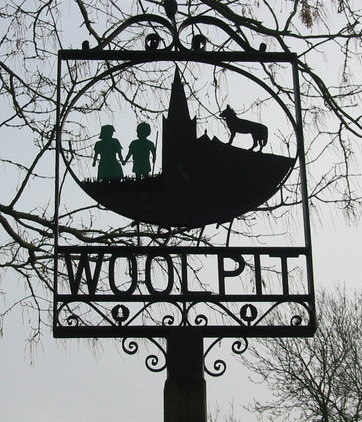
THE GREEN   CHILDREN OF WOOLPIT


Green Children of Woolpit


The green children of Woolpit reportedly appeared in the village of Woolpit in Suffolk, England, some time in the 12th century, perhaps during the reign of King Stephen. The children, brother and sister, were of generally normal appearance except for the green colour of their skin. They spoke in an unknown language, and the only food they would eat was green beans. Eventually they learned to eat other food and lost their green pallor, but the boy was sickly and died soon after the children were baptised. The girl adjusted to her new life, but she was considered to be "rather loose and wanton in her conduct". After she learned to speak English the girl explained that she and her brother had come from St Martin's Land, an underground world whose inhabitants are green.

The only near-contemporary accounts are contained in Ralph of Coggeshall's Chronicum Anglicanum and William of Newburgh's Historia rerum Anglicarum, written in about 1189 and 1220 respectively. Between then and their rediscovery in the mid-19th century, the green children seem to surface only in Bishop Francis Godwin's fantastical The Man in the Moone, in which William of Newburgh's account is reported.

Two approaches have dominated explanations of the story of the green children: that it is a typical folk tale describing an imaginary encounter with the inhabitants of another world, perhaps one beneath our feet or even extraterrestrial, or it is a garbled account of a historical event. The story was praised as an ideal fantasy by the English anarchist poet and critic Herbert Read in his English Prose Style, published in 1931. It provided the inspiration for his only novel, The Green Child, written in 1934


STORY


One day at harvest time, according to William of Newburgh during the reign of King Stephen (1135–1154), the villagers of Woolpit discovered two children, a brother and sister, beside one of the wolf pits that gave the village its name. Their skin was green, they spoke an unknown language, and their clothing was unfamiliar. Ralph reports that the children were taken to the home of Richard de Calne. Ralph and William agree that the pair refused all food for several days until they came across some green beans, which they consumed eagerly. The children gradually adapted to normal food and in time lost their green colour. The boy, who appeared to be the younger of the two, became sickly and died shortly after he and his sister were baptised.

Green Children of Woolpit


After learning to speak English the children – Ralph says just the surviving girl – explained that they came from a land where the sun never shone, and the light was like twilight. William says the children called their home St Martin's Land; Ralph adds that everything there was green. According to William the children were unable to account for their arrival in Woolpit; they had been herding their father's cattle when they heard a loud noise (according to William, the bells of Bury St Edmunds) and suddenly found themselves by the wolf pit where they were found. Ralph says that they had become lost when they followed the cattle into a cave, and after being guided by the sound of bells eventually emerged into our land.

According to Ralph the girl was employed as a servant in Richard de Calne's household for many years, where she was considered to be "very wanton and impudent". She eventually married a man from King's Lynn, about 40 miles (64 km) from Woolpit, where Ralph said she was still living shortly before he wrote. Based on his research into Richard de Calne's family history the astronomer and writer Duncan Lunan has concluded that the girl was given the name "Agnes", and that she married a royal official named Richard Barre.

Explanations Two approaches have dominated explanations of the mystery of the green children. The first is that it is a typical folk tale, describing an imaginary encounter with the inhabitants of a "fairy Otherworld". The second is that it is a garbled account of a real event, although it is impossible to be certain whether the story as recorded is an authentic report given by the children or an "adult invention". His study of accounts of children and servants fleeing from their masters led Charles Oman to conclude that "there is clearly some mystery behind it all [the story of the green children], some story of drugging and kidnapping"


MYSTERY--CROP CIRCLE


INTRODUCTION

 Crop Circles -formation, usually found in grain crops, where the crop has been mysteriously found laid flat, in patterns, that did not exist in daylight the previous day. Although thought by many to be a phenomena of the 20th Century, crop circles and formations have been around for a very long time, and records even date back well before the invention of the camera.
The most well known positive depiction of a crop circle is found in a woodcut made in 1678 with the title 'Strange News out of Hartford-shire’.
It depicts a devil-like creature cutting out a pattern in a crop with a scythe.
The woodcut has text, which told of a greedy farmer, who, having refused to pay a mower a reasonable rate for reaping his oats, swore that he would rather have the Devil do the work. The very following morning, the farmer awoke to find his crop had been harvested, but done so in such an amazing manner, with rounded circles of incredible exactness that no human could have done the same within the period and darkness of one night. The farmer was so afraid that he could not enter the field to collect his harvest.


It is suggested by some cryptologists and others that crop circles are depicted in prehistoric stone and wall carvings, such as in the spiral patterns carved in a stone at Newgrange in Ireland. For those that hold the view that crop circles are created by extra-terrestrials in spacecraft, some would say that reasonable recorded proof of this is depicted in some ancient Egyptian pictures.
The recorded incidence of crop circles in more modern times seems to have started in the early 20th century, with a gradual increase in numbers through to a marked incr4ease in the 1960’s, leading to a quite dramatic upturn in the 1990’s. At least 190 formations were discovered and documented in 1999, perhaps an omen for what is to come in the new millennium.


There are many who are under the impression that crop circles are only indigenous to the U.K. Sure, they are more prevalent here than elsewhere in the world, but there are countless examples of them appearing all over the world - in the USA from 1920, in Europe from the mid 20th century and in Africa, Canada, Australia, Central & Southern America, Russia in 1970, and Japan in the late 70’s.
Many visitors to the U.K. are amazed to discover that crop circles actually appear in their own country.
What odds, that formations in the 21st century will be found on the Surface of the Moon and Mars, and beyond?